Here's what you need to know first
You can orgasm alone. But the moment your partner is in the room, your body goes silent. The pleasure doesn't vanish. Your nervous system does. Performance anxiety hijacks the process, turning something that should feel good into an obligation you can't meet. And then the shame spiral starts.
This is wildly common. It's also completely fixable.
Why your body shuts down when someone else is watching
Orgasm requires a specific state. Your brain needs to be present, your nervous system needs to feel safe, and your body needs to trust that it's allowed to let go. Performance anxiety does the opposite on every front.
When your partner is present, part of your brain is running a parallel conversation: "Am I taking too long? Do they look bored? What if this doesn't happen?" That mental loop triggers your sympathetic nervous system (the fight-or-flight response), which literally suppresses the parasympathetic activation that orgasm requires. You can't relax and perform simultaneously. Your body will choose relaxation avoidance every time to protect you from perceived threat.
Add in cultural messaging that orgasm should be spontaneous and effortless, and you're stuck. The harder you try, the further away it moves.
The role of attention and monitoring
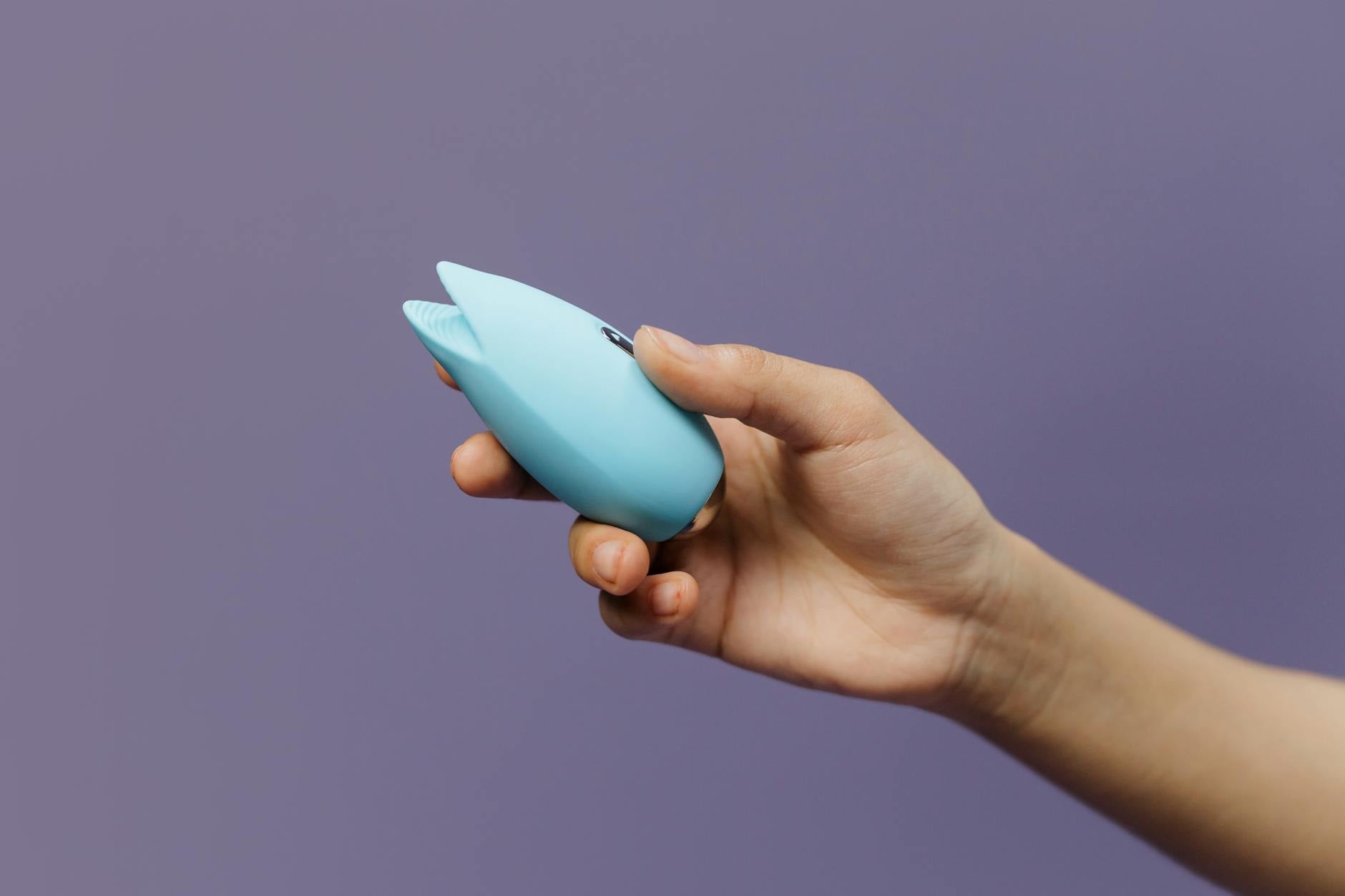
I see this pattern constantly in my work with couples. When you're alone with a lemon vibrator or any tool, your attention stays on sensation. You're tracking the rhythm, the pressure, the buildup. That's the entire point.
With a partner present, your attention splits. You're monitoring their response, their patience, their enjoyment. You're tracking the time. You're worried about your body's appearance, your sounds, your smell. That's not focus. That's surveillance.
Clitoral pleasure is exquisitely attention-dependent. The clitoris has 8,000 nerve endings concentrated in a space the size of a pea. It responds to precision. When your mind is scattered across seven different monitoring tasks, those nerves can't register the subtle building that leads to orgasm.
Why Lemon vibrators shift the dynamic
Lemon clitoral vibrators work differently than partner stimulation. They provide consistent, focused, predictable sensation. There's no variation based on your partner's mood, energy, or interpretation of what feels good. That predictability is not boring. It's permission.
When you introduce a Lemon vibrator into partnered sex, several things change at once:
First, the locus of control becomes clearer. You're holding the device. You're controlling the pressure, the pattern, the pace. Your partner is present, but they're not the source of the stimulation. That distinction matters psychologically. You can relax into pleasure without worrying about burdening your partner with the "responsibility" of making you come.
Second, it removes the time pressure. Partner stimulation often has an implicit deadline. If it's been 20 minutes of oral or manual work, there's ambient pressure (even if neither of you speaks it aloud) to wrap up. A Lemon vibrator gives you the ability to extend or shorten the experience based on what your nervous system needs. No negotiation required.
Third, it reduces the performance spectacle. You're focused on the device, the sensation, your breath. Your partner can participate in the moment without being cast as the solo actor responsible for your orgasm.
Starting with solo exploration first
Before introducing a Lemon vibrator into partnered sex, get comfortable with it alone. This sounds simple, but it's the foundation.
When you use a lemon clitoral vibrator solo, you're learning something crucial: what your body actually needs to orgasm. Not what you think you should need. Not what feels efficient. What your nervous system genuinely responds to. The intensity level, the rhythm pattern, the pacing, the buildup time. All of it.
That information is gold. When you eventually use the vibrator with your partner, you know exactly where to start, how much pressure helps, and what sequence works. You're not discovering this in real time while your partner watches and waits.
Spend at least two to four weeks using your Lemon vibrator alone before introducing it to partnered sex. Focus on noticing what changes in your body. What rhythm makes you catch your breath? What pattern sustains the buildup? Do you orgasm faster if you start at intensity level two or three? All of this data belongs only to you.
Introducing it to your partner gradually
The transition doesn't have to be abrupt. Start by mentioning it casually. "I've been exploring something that feels really good, and I'd like to try it when we're together." That's it. No justification, no apology.
The first time you use it with your partner present, you might just hold it and let them watch. No pressure for an orgasm. Just sensation. Five minutes. Then stop. The goal is to normalize the device in the space between you. It's not a tool of last resort. It's not a failure. It's just part of your pleasure toolkit.
After you've done that a few times, you can build toward partnered sex. Maybe your partner penetrates you while you use the vibrator on your clitoris. Maybe they're beside you, touching your body elsewhere while you handle the vibrator. Maybe they take a step back entirely and you use it while they watch. The specific configuration matters far less than your comfort level.
What to watch for (and what to ignore)
Your partner might feel displaced or inadequate. That's their nervous system, not your responsibility. You can reassure them ("This helps me get there, and I want you to experience that with me"), but you can't manage their insecurity by avoiding your own pleasure.
You might feel guilt about "needing" the vibrator. You don't need it. Your nervous system benefits from it. Your clitoral tissue might respond better to suction (if you're using a lemon vibrator with suction technology) than to manual friction. That's biology, not brokenness.
You might worry that using a vibrator means your partner's touch will never be enough. That's a different conversation, and an important one. But it's not true that adding a vibrator to your repertoire means subtracting connection. You're adding precision, not removing intimacy.
The patience piece (yours and theirs)
Rewiring a nervous system takes time. You've probably been unable to orgasm with your partner present for months or years. Your body has learned a protective pattern. That pattern didn't form overnight, and it won't dissolve overnight either.
Expect setbacks. Some nights, even with the vibrator and your partner's support, nothing will happen. That's not failure. That's your nervous system saying it's not ready that night. Respect that. Put the vibrator down. Move your body. Try again tomorrow.
If your partner can stay present without expectation during those moments, that's the real intimacy. Not the orgasm. The willingness to be together without an agenda.
When to seek additional support
If you've been using a Lemon vibrator alone and with your partner consistently for two to three months and still can't reach orgasm, the block might be deeper than performance anxiety. Sometimes past sexual trauma, deep shame, or relationship disconnection requires external support.
That's what I'm here for. A therapist trained in sex-positive approaches can help you untangle what's happening and build a genuine pathway to pleasure. The vibrator is a tool. Sometimes you need help learning how to use it.
What comes next
Orgasm with a partner present is not the finish line of your sex life. It's a waypoint. Once you get there, you'll likely discover that you want more: longer sessions, different positions, deeper exploration of what else feels good. That's the real victory. Not the orgasm itself, but the trust that your body deserves pleasure and the permission to pursue it.
A Lemon clitoral vibrator can absolutely be part of that journey. But the real shift happens when you decide that your pleasure matters enough to be honest about what you need.